Executive Summary
Background
What is the funded enrollment cap?
The funded enrollment cap sets a limit on how much funding a school district receives to fund special education programs and services. Currently, districts can only generate state special education funding for up to 16% of their students, even if they provide special education services to more than 16% of their students. For more detailed information:
How does this impact districts?
If a district has identified 18% of their students as needing special education services, they will only receive state funding for up to 16% of those students. The additional 2% of students ‘over the 16% cap’ don’t generate additional state funding for a district. However, districts are still required by state and federal law to provide special education services to all students who qualify to receive special education services.
How does Washington fund special education?
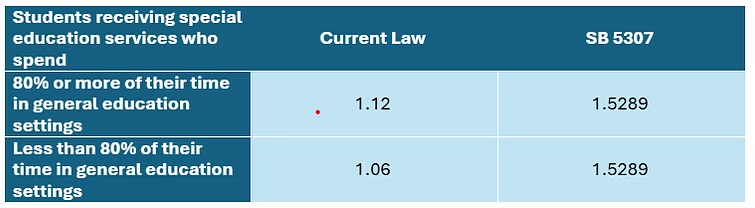
Washington uses multipliers in its special education funding formula to calculate how much funding students and schools should get. The higher the multiplier, the more funding schools receive to provide special education services.
The amount of funding generated through these multipliers is based on how much of the time a student spends in the general education setting. General education classrooms include students with and without an individual education program (IEP). A higher multiplier is used to generate funding for students who are in the general education classrooms for 80% or more of the day. This is to encourage broader adoption of practices that include students in the general education classroom more often, instead of placing them in secluded classrooms with only other students who receiving special education services.
Summary
-
This bill would remove the funded enrollment cap for all districts starting in the 2025-26 school year.
-
The proposal would also increase the funding multiplier for special education increasing how much the state provides to districts to support the special education needs of students.
-
The proposed changes also include eliminating the two-tiered special education funding system that provides more funding to districts who are served in the general education setting for 80% or more of the time.
Key Points
Historically, students with disabilities have been excluded from public education, segregated from students without disabilities, and not meaningfully included in the general education classroom. Washington has taken steps in recent years to address these historic practices, but are still in the process of creating a system that is inclusive and welcoming to all students.
In July 2024, 137 of the state’s 295 school districts were above the current 16% enrollment cap. These districts are not receiving enough funding from the state and therefore rely on other sources of funding (such as local funding generated by local property taxes) to provide special education services.
If this proposal passed, it would cost about $1.56 billion for the upcoming 2-year budget.
Ways to Get Involved
Steps to Get Started
- Learn where the bill is in the legislative process.
- If there is an upcoming hearing, decide how you would like to get your voice heard and take action.
- If there is not an upcoming hearing, or if you want to supplement your advocacy, call or write your legislators.
- Spread the word and get other people on board.
Participating in a Hearing

Sign in Pro, Con, or Other
This is when individuals, advocates, and organizations make their position on a particular bill known for the record. This is particularly powerful in large numbers. Many organizations will send out Action Alerts asking people to sign in Pro or Con on a bill.
Submit Written Testimony
Submitting written testimony is a great way not only to make your position known to legislators but also to explain why in more detail. This is a good option if you don’t want to speak in front of others. People also like to offer more nuance to their position by writing.
Testify Virtually
Since COVID, many legislators are allowing remote/virtual testimony for bill hearings, as it greatly expands access to the legislative process across the state. For this, individuals usually have between 1-2 minutes to state their opinion on a bill in front of the legislative committee on Zoom.